

By Tim Landy
A lot of our clients have asked us some version of the same question this year: “What does the situation overseas actually mean for buying or selling a home in Austin?” It’s a fair question. This post isn’t about the politics of the conflict. We’re only looking at the economics, using public data, so you can see what has changed and make your own decisions with clear eyes.
Here’s the short background. On February 28, 2026, the United States and Israel began military strikes on Iran, and the conflict has continued since then, with a ceasefire in April that has been extended at times and talks that are still going on as of this week.
Below is what the numbers show from late 2025 through the most recent data available.
Oil and gasoline: the first and biggest shock
Energy prices are where the conflict showed up first. A large share of the world’s oil and liquefied natural gas normally moves through the Strait of Hormuz, and shipping there has been badly disrupted.
- Brent crude was $71.32 per barrel on February 27, 2026, the last trading day before the strikes.
- It peaked at $138.21 on April 7, 2026.
- After easing to around $70 in early July, it climbed again and was $125.44 on October 6, 2026, the latest daily spot price in FRED.
Futures prices have been running well below that spot figure (news reports put front month Brent near $106 this week), which tells you how tight physical supply still is right now.
At the pump, the U.S. average for regular gasoline went from $2.94 a gallon (week of February 23) to a high of $4.50 (week of May 11), and was $4.35 for the week of October 5.
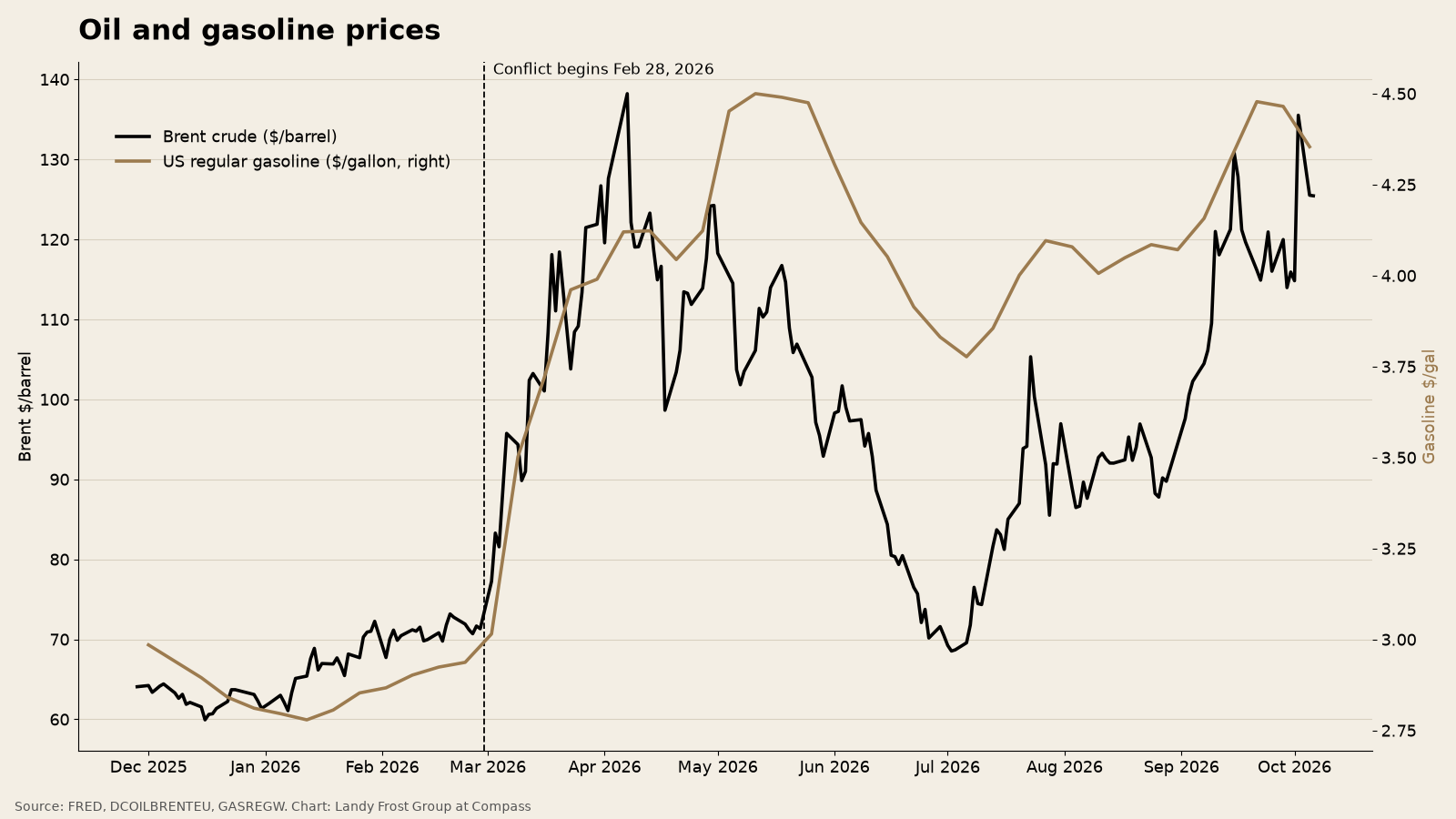
Brent crude and U.S. regular gasoline prices. Source: FRED, DCOILBRENTEU and GASREGW.
For an Austin household, that’s real money. Higher fuel costs touch commuting, deliveries, groceries, and construction materials.
Inflation: back above where it started the year
Energy feeds into almost everything, so it isn’t surprising that overall inflation picked up.
- Consumer prices (CPI) were up 2.43% year over year in February 2026.
- That rose to 4.17% in May 2026.
- The latest reading, August 2026, was 3.35%.
So inflation has cooled from its spring peak, but it’s still about a full point higher than it was before the conflict.
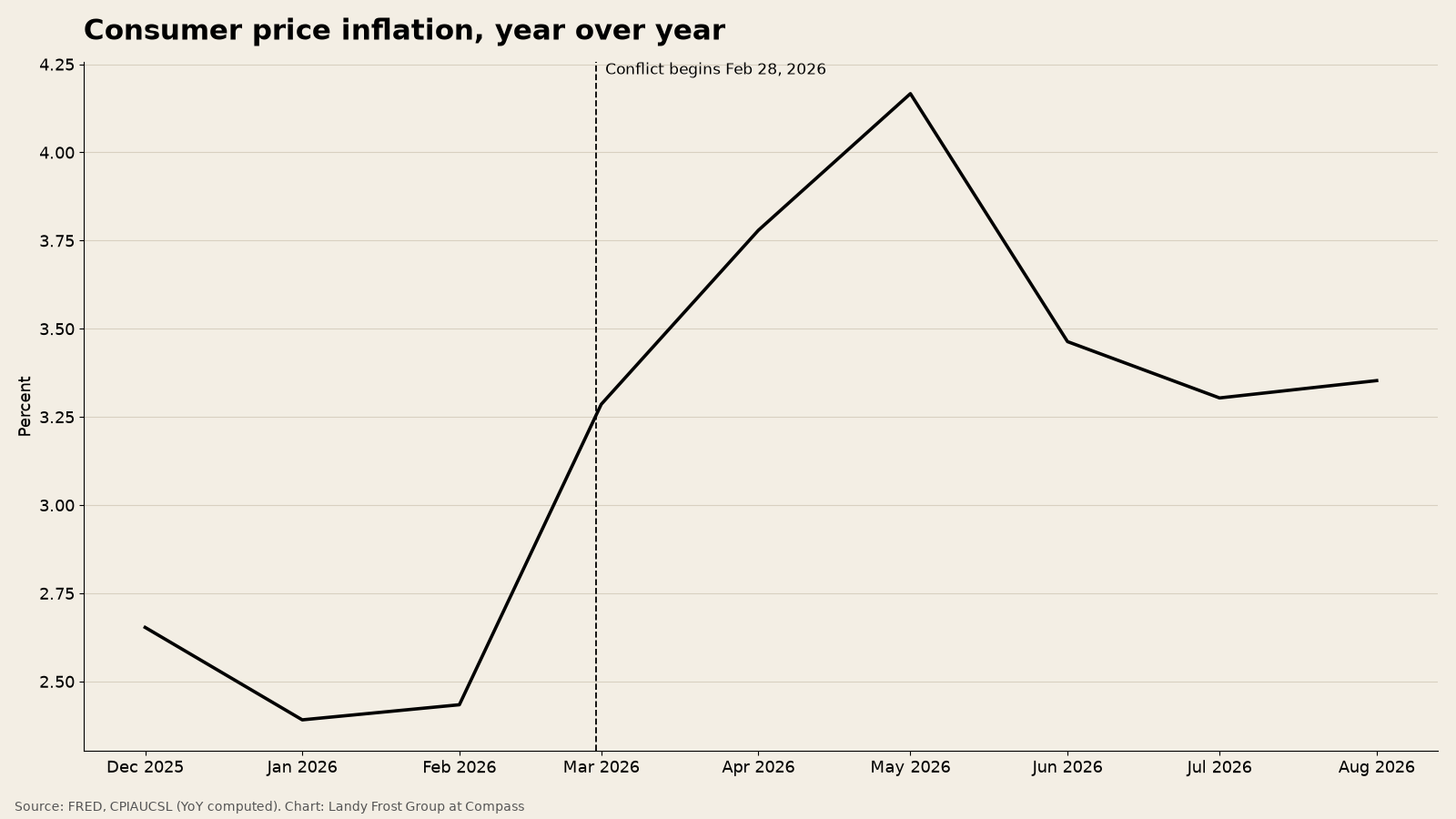
Consumer price inflation, year over year. Source: FRED, CPIAUCSL.
The 10-year Treasury and mortgage rates
This is the part that matters most for housing. Mortgage rates tend to track the 10-year Treasury yield, and that yield responds to inflation expectations.
- The 10-year Treasury yield was 3.97% on February 27, 2026. It was 5.24% on October 9, 2026, after touching 5.31% on October 5.
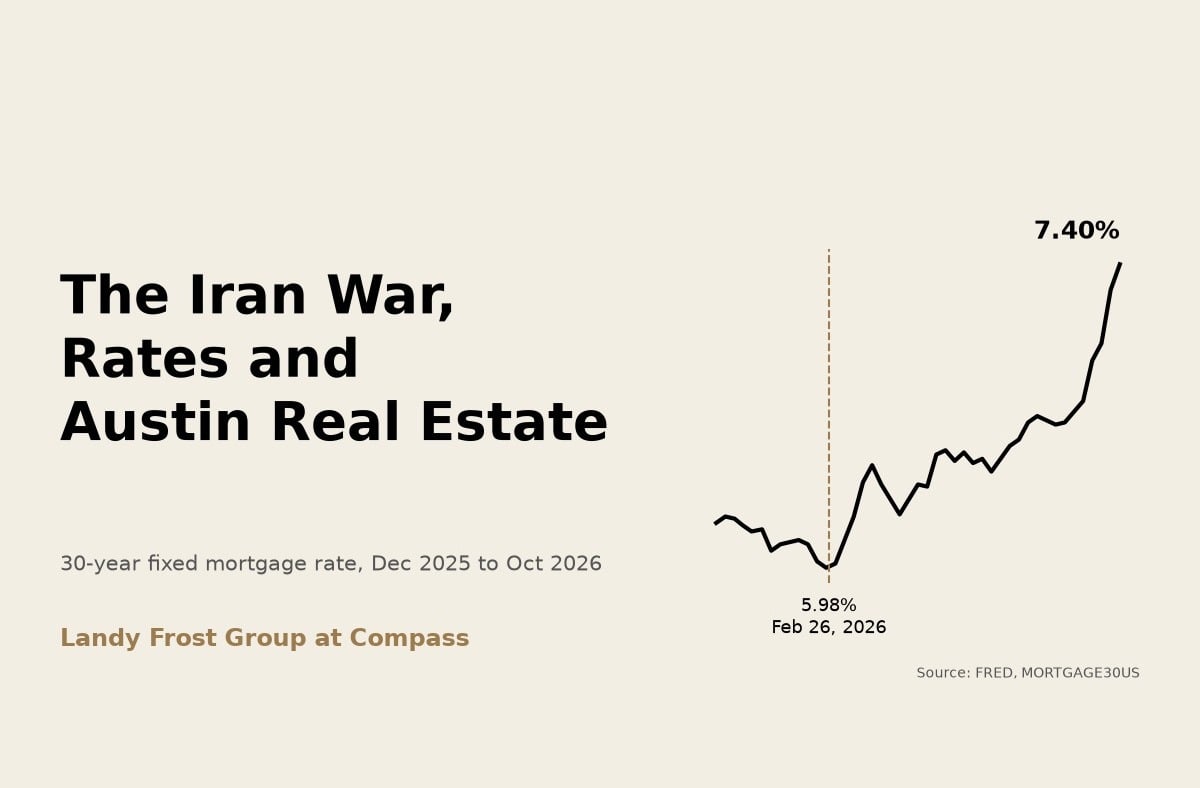
- Freddie Mac’s average 30-year fixed rate was 5.98% on February 26, 2026. It was 7.40% on October 8, 2026, the highest reading since the conflict began.
- The effective federal funds rate went from 3.64% in late February to 3.88% as of October 12, 2026.
In plain terms, mortgage rates have risen about 1.4 percentage points since late February, and most of that move has come in the past two months.
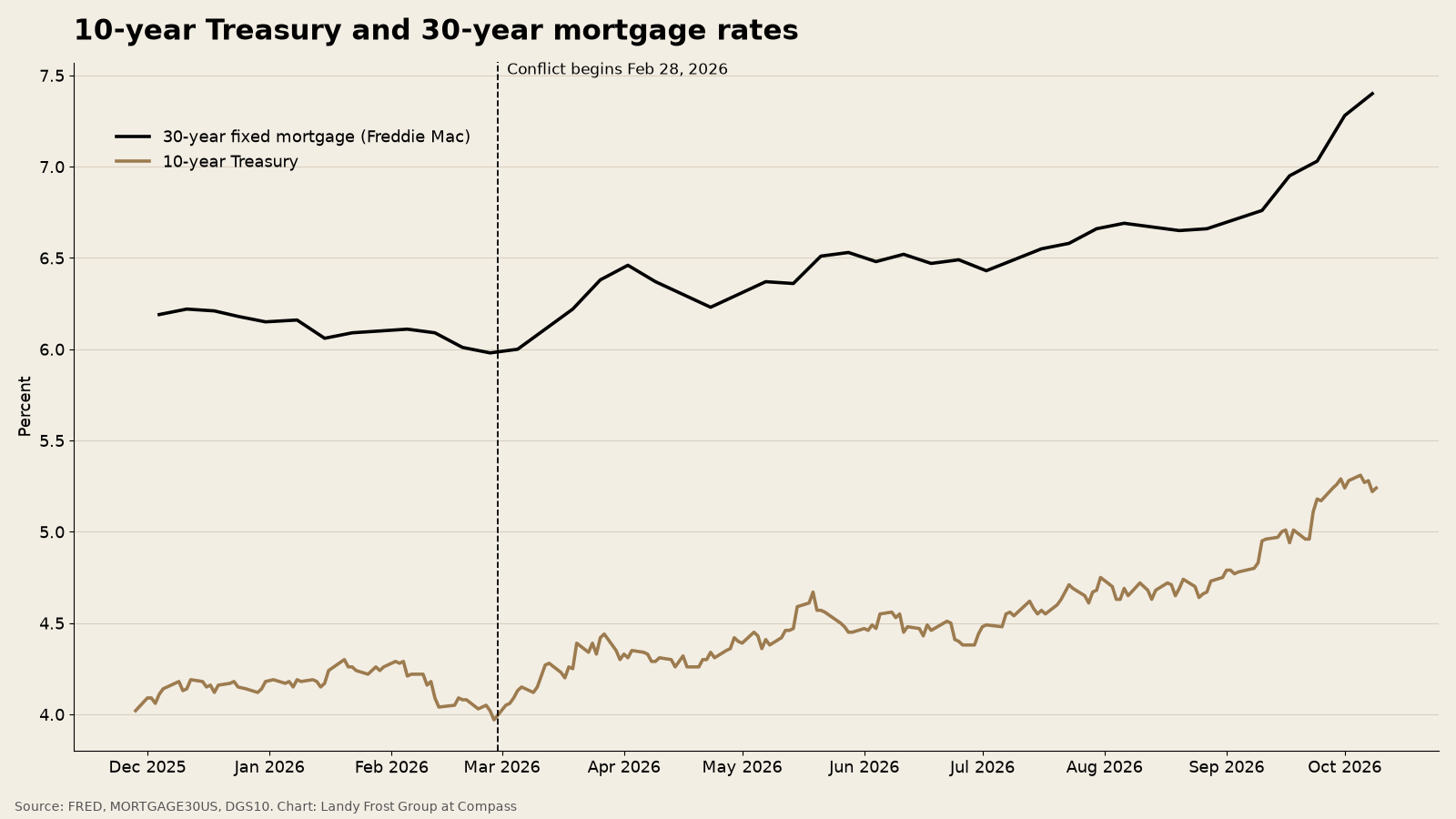
30-year fixed mortgage rate and 10-year Treasury yield. Source: FRED, MORTGAGE30US and DGS10.
What does 1.4 points mean in dollars? On a $400,000 loan, the principal and interest payment at 5.98% is about $2,393 a month. At 7.40% it’s about $2,770. That’s roughly $377 more every month, or about $4,500 a year, for the same house. We dig into how that kind of rate move tends to play out in what happens to home prices when mortgage rates rise.
What’s happening in Austin
Austin came into 2026 with more homes for sale than in recent years, and that trend continued.
- Active listings in the Austin metro were 9,080 in February 2026, rose to 12,655 in July, and were 12,083 in September 2026.
- The median list price was $454,500 in February, reached $475,000 in April and May, and was $446,450 in September 2026.
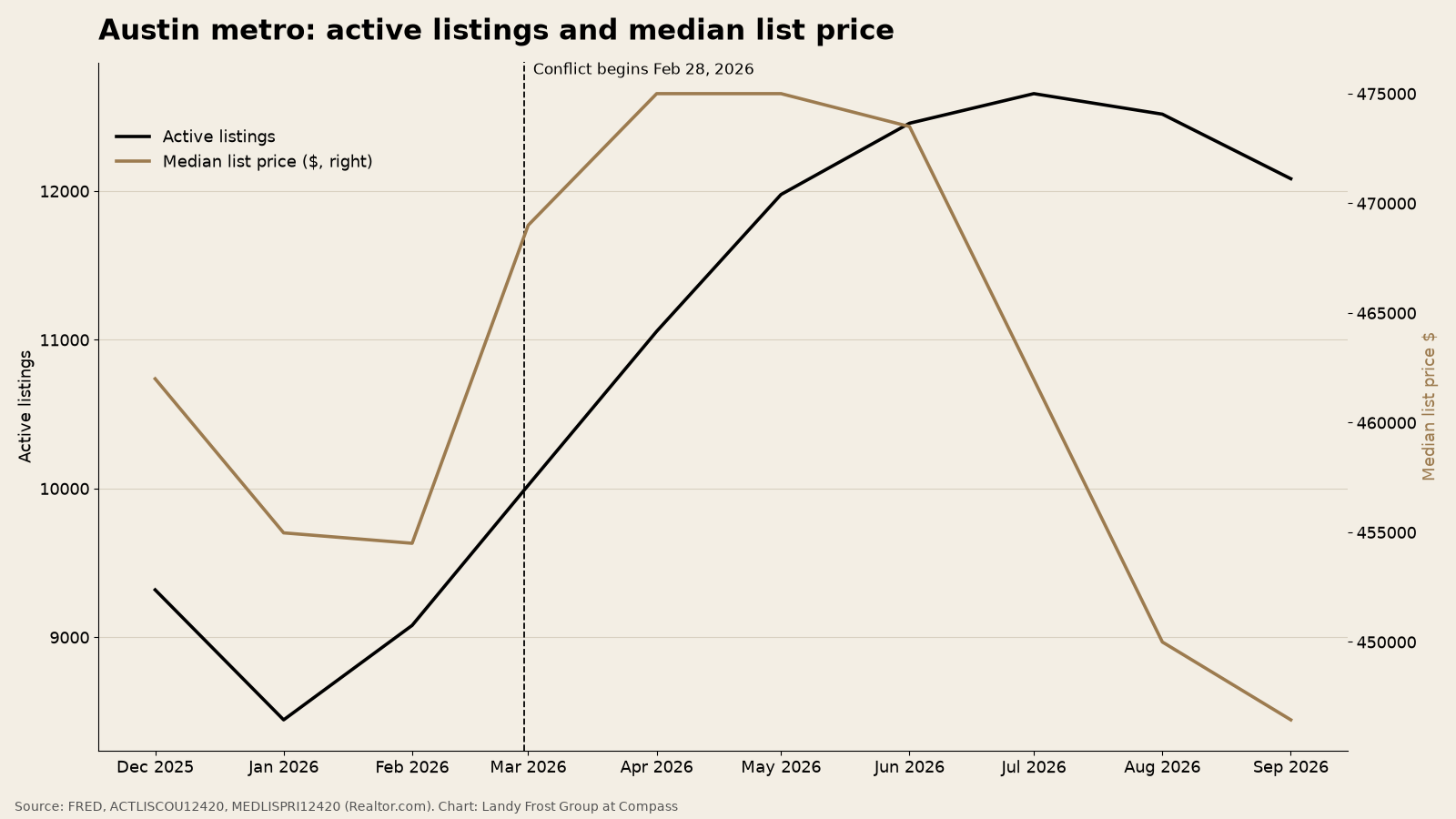
Austin metro active listings and median list price. Source: FRED, ACTLISCOU12420 and MEDLISPRI12420 (Realtor.com).
Some of that is the normal seasonal pattern, since spring brings more listings. But the combination of more inventory and higher borrowing costs has given buyers more choice and more room to negotiate than they’ve had in a while, while sellers are seeing more competition. For the longer view of how Austin got here, see what Austin’s housing market would look like if the pandemic never happened.
The rate lock effect
Many Austin homeowners have mortgages with rates well below today’s 7.40%. When rates rise, some of those owners decide to stay put rather than trade a low rate for a higher one. That can keep some homes off the market, even as others list because of job moves, family changes, or simply wanting to get ahead of further changes. How those forces balance out is something we watch closely, neighborhood by neighborhood.
What this means for you
If you’re buying
- Get a fresh pre-approval at today’s rates. Your budget from last winter may not be your budget today.
- Look at the full monthly payment, including taxes and insurance, not just the price.
- With more listings to choose from, you may have room to negotiate on price, repairs, or seller paid closing costs. A lower price or a closing cost credit can be more useful than a short term rate buydown, which only lowers your payment for a year or two before it resets. We compare the options in rate buydown or lower price in Austin.
- If you’re comfortable with the payment and find the right home, nobody can time rates perfectly. If rates come down later, refinancing may be an option, but it depends on your situation and isn’t guaranteed.
If you’re selling
- Pricing matters more than it did last spring. Buyers are comparing more homes and running the numbers carefully.
- Presentation and condition count. Homes that are ready to move into tend to stand out when buyers have options.
- Think about your next move together with your sale. If you’re buying again, your new rate is part of the decision.
If you’re waiting
That’s a reasonable choice too. Keep an eye on energy prices, inflation reports, and the 10-year yield. They’ve been the clearest signals of where mortgage rates have been heading this year.
Nobody knows how the conflict or the talks will unfold, and we won’t pretend to. What we can do is help you understand the numbers for your own situation.
Let’s talk it through
If you’re wondering how this year’s changes affect your plans, we’d love to help. Call or text 512-693-8578, email [email protected], or reach out here for a no pressure conversation about your goals, your budget, or what your home might sell for in today’s Austin market.
Sources
- FRED: Brent crude oil price (DCOILBRENTEU)
- FRED: U.S. regular gasoline price (GASREGW)
- FRED: Consumer Price Index (CPIAUCSL)
- FRED: 10-year Treasury yield (DGS10)
- FRED: Freddie Mac 30-year fixed mortgage rate (MORTGAGE30US)
- FRED: Effective federal funds rate (DFF)
- FRED: Austin metro active listings, Realtor.com (ACTLISCOU12420)
- FRED: Austin metro median list price, Realtor.com (MEDLISPRI12420)
- ABC News: timeline of the February 28, 2026 strikes
- Ship Universe: Strait of Hormuz shipping update
Landy Frost Group at Compass