

By Tim Landy · September 1, 2026

The Austin housing market has spent the last several years trying to find its way back to normal.
But what does “normal” actually mean?
Instead of comparing today’s market to the pandemic peak or simply looking at year over year changes, I wanted to ask a different question:
What would Austin home prices and inventory look like today if the pandemic housing boom had never happened?
To find out, I looked at Austin’s single family housing data from 2005 through 2026 and compared today’s market with its pre pandemic trend.
Source: Unlock MLS single-family median sale price and active inventory, 2005 through 2026. Trend comparison and analysis by Landy Frost Group.
The results tell an interesting story.
Home prices have essentially returned to their long term trend. Inventory hasn’t just recovered. It has blown past it.
Austin Home Prices Are Finally Back to Trend
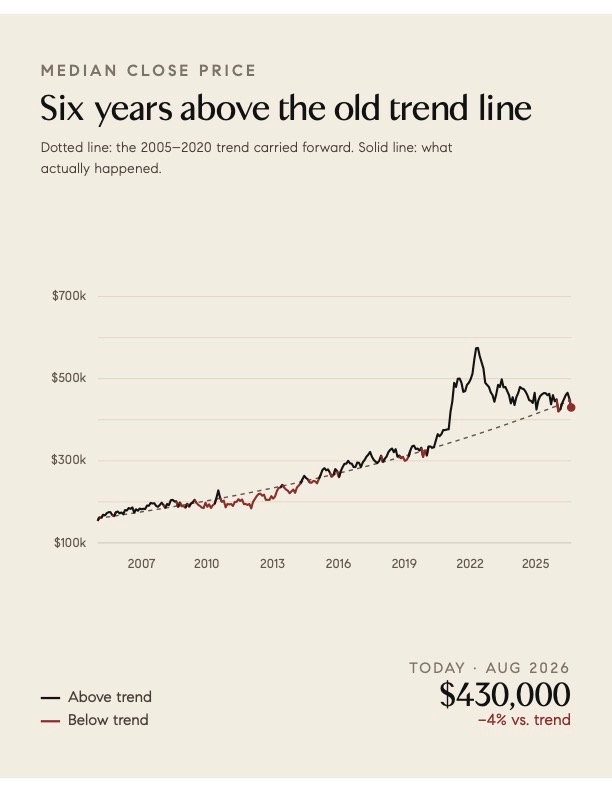
During the pandemic, Austin home prices moved dramatically above their historical trajectory.
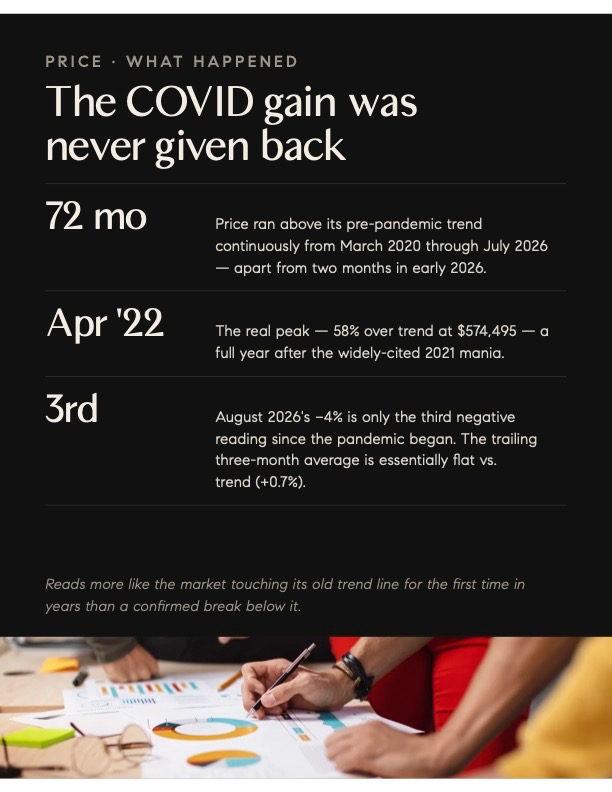
And despite the correction that followed, prices remained above that pre pandemic trend for years.
That has finally changed.
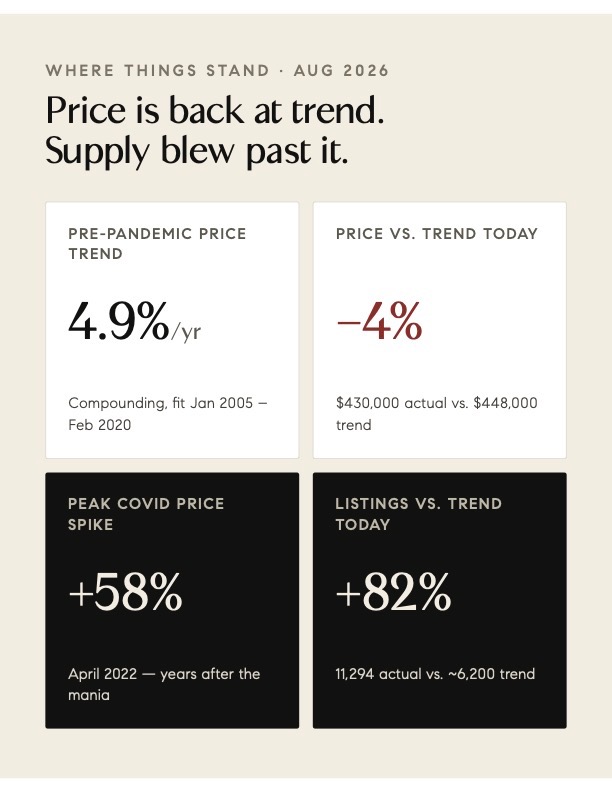
As of the latest data, Austin’s median single family home price is roughly 4% below where the pre pandemic trend suggests it would be today.
In other words, after years of extraordinary appreciation followed by a significant correction, Austin home prices are essentially back to where the market’s longer term trajectory suggests they might have been if the pandemic boom never occurred.
That doesn’t necessarily mean prices have found a bottom.
To understand why, we need to look at the other side of the market.
Austin Housing Inventory Has Overshot “Normal”
Inventory tells almost the exact opposite story.
Austin entered the pandemic with housing supply collapsing.
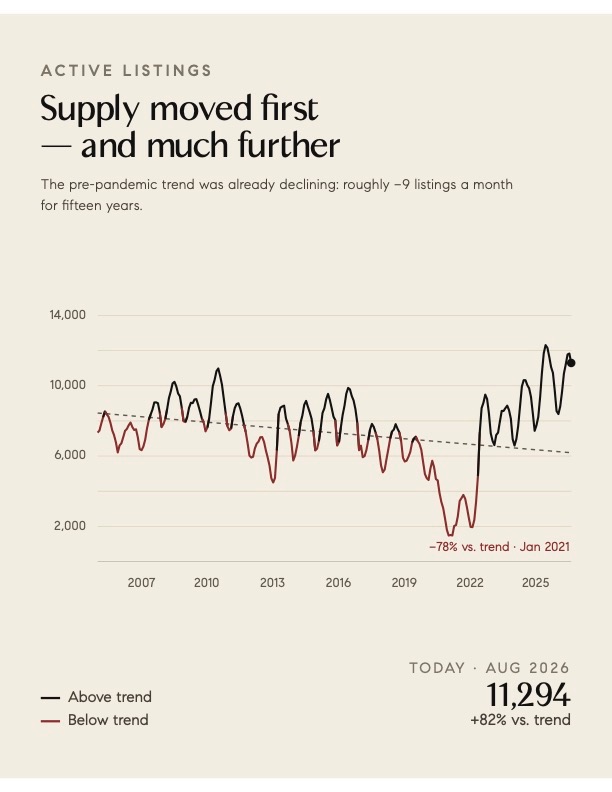
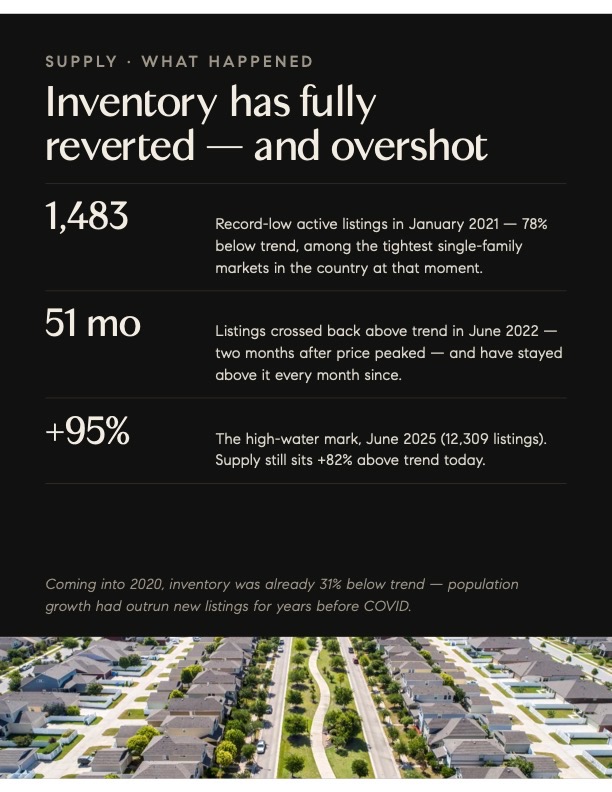
By January 2021, single family inventory had fallen approximately 78% below its pre pandemic trend.
That extreme shortage helped create the conditions for the price acceleration that followed. Buyers were competing over very few available homes, and prices moved sharply higher.
But the inventory story eventually reversed.
More homes came onto the market. Buyer demand cooled. Mortgage rates increased. Homes took longer to sell.
Supply rebuilt.
And then it kept going.
Today, Austin single family inventory sits approximately 82% ABOVE its pre pandemic trend.
That may be the most important number in the current market.
We’ve gone from an extraordinary shortage of homes to substantially more inventory than Austin’s previous trajectory would have suggested.
Price Is Back to Normal. Supply Isn’t.
Put the two together and the current market becomes easier to understand.
Price has essentially returned to trend.
Inventory has significantly overshot trend.
That creates an unusual dynamic.
The price correction has already been substantial, but buyers now have far more choice than they did during both the pandemic boom and what the historical trend would suggest is “normal.”
If inventory remains this elevated, there could still be pressure on prices, particularly for homes that are dated, poorly positioned, or priced above what buyers are willing to pay.
But that doesn’t mean every home is struggling.
What We’re Seeing on the Ground in Austin
The Austin market isn’t behaving like one uniform market.
Good homes that are updated, well located, and correctly priced can still attract significant buyer interest. In some cases, we’re seeing multiple offers again.
At the same time, homes that miss the mark on price, condition, or presentation can sit.
That distinction matters.
Headlines about rising inventory or falling prices can make it sound as though every seller is facing the same conditions. They aren’t.
Buyers have more leverage and more choices than they did a few years ago, which means they can be more selective.
For sellers, that makes pricing and positioning increasingly important.
The market can still reward a great property.
It’s simply much less forgiving of an overpriced one.
So, Has Austin Housing Finally Corrected?
In terms of price, we may be much closer to “normal” than many people realize.
Austin’s median single family price has now effectively returned to its pre pandemic trend.
But inventory suggests the adjustment may not be completely finished.
With supply approximately 82% above trend, the question isn’t simply whether Austin prices have already fallen.
The more interesting question is:
What happens if this much inventory sticks around?
If buyers absorb it, price stabilization could follow.
If inventory remains elevated or continues growing, prices may have more room to soften before the market reaches a more sustainable balance.
Either way, comparing today’s market with the pandemic peak misses the bigger picture.
The Austin housing market went through an extraordinary disruption. Inventory collapsed, prices surged, supply recovered, and prices corrected.
Now, for the first time in years, we can start to see where the market sits relative to the trajectory it was on before any of that happened.
And right now, the data says something pretty clear:
Price is back at trend. Supply blew past it.
Want to Know What This Means for Your Austin Neighborhood?
Citywide numbers are useful, but Austin real estate is highly localized. Inventory, pricing, buyer activity, and competition can look very different from one neighborhood or even one price point to another.
If you’re considering buying or selling in Austin and want to understand what’s happening in your specific part of the market, reach out. We’re happy to dig into the numbers with you.
Check out this article next